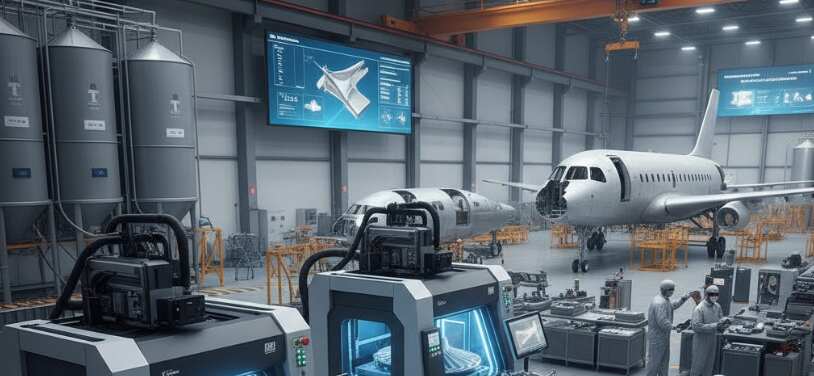
What if you could build metal parts without ever melting metal—stronger, lighter, and with almost zero waste? That’s not science fiction; it’s powder metallurgy, a manufacturing method quietly shaping the engines, aircraft, medical implants, and tools we rely on every day.
From microscopic metal powders to precision-engineered components, powder metallurgy turns fine grains into high-performance parts with remarkable efficiency and control. It’s the reason complex shapes, tight tolerances, and advanced material properties are no longer limitations—but advantages.
In the following discussion we will be exploring everthing necessary to understand the powder metallugy in aviation in easy way.
What is Powder Metallurgy?
Powder metallurgy is a manufacturing process in which fine metal powders are compressed into a desired shape and then heated (sintered) to bond the particles together. This process allows engineers to create complex components with high precision, minimal material waste, and exceptional strength-to-weight ratios.
Key Steps in Powder Metallurgy
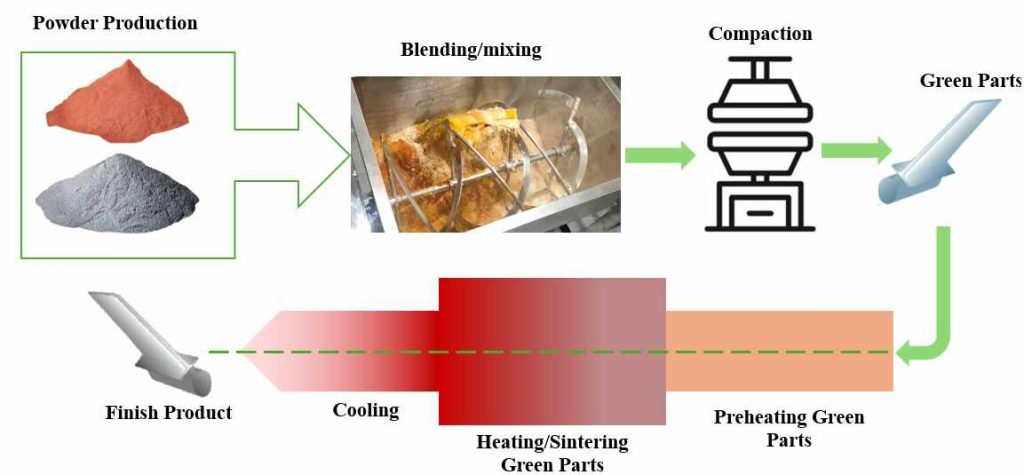
- Powder Production – Metals like titanium, aluminum, and nickel are converted into fine powders using atomization or chemical methods.
- Blending – Different metal powders and additives are mixed to achieve the required material properties.
- Compaction – The powder is pressed into molds under high pressure to form “green” parts.
- Sintering – The green parts are heated below their melting point, allowing particles to fuse and achieve structural integrity.
- Post-Processing – Techniques like machining, heat treatment, or surface finishing enhance performance.
Advantages of Powder Metallurgy in Aviation
- Lightweight Components: Reduces aircraft weight, improving fuel efficiency.
- High Precision: Complex geometries and tight tolerances are achievable.
- Material Efficiency: Minimal waste compared to casting or machining.
- Enhanced Mechanical Properties: High strength, wear resistance, and thermal stability.
Common Defects in Powder Metallurgy
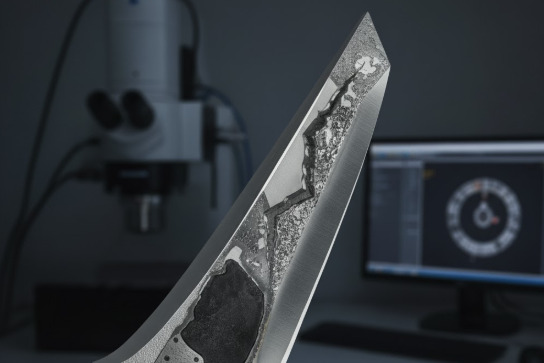
While PM offers many benefits, manufacturing defects can occur if processes are not strictly controlled. Common defects include:
- Porosity – Small voids inside the part due to insufficient compaction or incomplete sintering.
- Cracks – Caused by thermal stresses during sintering or post-processing.
- Oxidation – Surface oxidation can occur if powders are exposed to air during sintering.
- Inclusions – Foreign particles trapped in the metal matrix reduce strength.
- Dimensional Variations – Shrinkage during sintering can cause deviations from design dimensions.
- Density Inconsistency – Uneven pressing or powder distribution leads to weak zones.
Powder Metallurgy in Aviation Applications
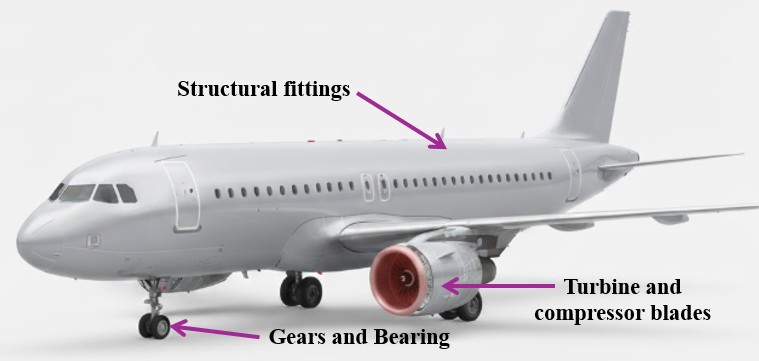
Powder metallurgy is widely used in aerospace for both structural and engine components:
- Turbine Blades – Nickel-based superalloys produced via PM provide exceptional high-temperature performance.
- Gears and Bearings – PM components ensure wear resistance and durability while reducing weight.
- Landing Gear Components – Precision PM parts contribute to safe and reliable operations.
- Structural Fittings – Lightweight brackets, fasteners, and housings optimize aircraft efficiency.
Examples of Powder Metallurgy Use in Aircraft like A320neo
The A320neo, a next-generation single-aisle aircraft, incorporates PM technology in several areas:
- Engine Components: Turbine disks and blades, where powder metallurgy ensures durability under extreme heat.
- Landing Gear and Actuation Systems: Lightweight PM gears and bearings reduce weight without compromising strength.
- Fuel System Components: High-precision PM parts improve flow control and reliability.
Impact of Powder Metallurgy Defects on Airlines
Defects in PM components can directly affect airline operations and safety:
- Engine Reliability Issues – Porosity or cracks in turbine blades may lead to premature engine wear or failure, increasing maintenance costs.
- Increased Maintenance Frequency – Components with inconsistent density or inclusions require more inspections and replacements.
- Operational Safety Risks – Structural failures, though rare, can have severe consequences if defects go undetected.
- Cost Implications – Airlines may face higher operational and maintenance costs due to part replacement or early overhauls.
Mitigation Strategies
Airlines and manufacturers implement several measures to minimize PM defects:
- Non-Destructive Testing (NDT) – X-ray, ultrasonic, and CT scanning detect internal porosity or cracks.
- Quality Control During Powder Production – Ensures uniform particle size and purity.
- Precision Sintering Processes – Controlled temperature and atmosphere reduce oxidation and shrinkage.
- Advanced Simulation Tools – Predicts part behaviour during compaction and sintering.
Engine Shortages and Their Impact on Aircraft like A320neo
Despite the advantages of powder metallurgy, recent challenges have highlighted vulnerabilities in the aviation industry. A significant issue is the global shortage of next-generation, fuel-efficient engines, particularly Pratt & Whitney’s GTF engines. This shortage has led to the grounding of nearly one-third of the GTF-powered Airbus fleet, including the A320neo family.
In some cases, aircraft are being dismantled for their engines, as the engines themselves have become more valuable than the entire aircraft. This trend underscores the critical role of engine reliability and availability in the overall performance and sustainability of aircraft like the A320neo.
Root Causes of Engine Shortages
The engine shortage crisis stems from several interrelated factors:
- Production Delays: Manufacturers are struggling to meet the high demand for engines, leading to significant delays in deliveries.
- Maintenance Backlogs: Existing engines require more time for maintenance and repairs, further exacerbating the shortage.
- Supply Chain Disruptions: Global supply chain issues, including shortages of critical materials and components, have hindered engine production.
- Increased Demand: The resurgence of air travel post-pandemic has led to a surge in demand for new aircraft and engines.
Financial Impact on Airlines
The ongoing engine shortages are imposing substantial financial burdens on airlines:
- Increased Fuel Costs: Operating older, less fuel-efficient aircraft due to delayed deliveries of new ones has led to an estimated $4.2 billion in additional fuel expenses in 2025.
- Higher Maintenance Expenses: Extended maintenance periods and the need for more frequent repairs on aging aircraft have resulted in approximately $3.1 billion in extra maintenance costs.
- Engine Leasing Costs: The shortage has driven up the cost of leasing engines during maintenance delays, adding about $2.6 billion to airline expenditures.
- Spare Parts Inventory: Airlines are stockpiling spare parts to mitigate supply chain risks, leading to an additional $1.4 billion in costs.
Case Studies
- Turkish Airlines: As of October 2025, Turkish Airlines has 45 Airbus jets grounded due to unusually long Pratt & Whitney repair waiting times. The airline started the year with 35 jets left idle and expects the situation to continue into 2026.
- Wizz Air: The European low-cost carrier has 38 aircraft currently grounded due to engine supply chain disruptions. The airline aims to resolve these issues by the end of 2027, though this goal is not guaranteed.
Conclusion
Powder metallurgy is a cornerstone of modern aviation manufacturing, offering lightweight, high-strength components that enhance aircraft efficiency and performance. While defects like porosity, cracks, and density inconsistencies can occur, strict quality control, advanced testing, and precision engineering minimize risks.
For aircraft like the A320neo, PM components ensure reliable performance, but understanding and mitigating defects remain critical for airlines to maintain safety and reduce operational costs.