Interest in large stealth aircraft China has surged because Beijing is moving beyond early stealth programs and toward larger low-observable platforms — not only heavier fifth-generation fighters but also possible long-range bombers and flying-wing demonstrators. Photographs, satellite imagery and rapid production signals have intensified scrutiny of whether China can field a family of large stealth aircraft capable of regional power projection and strategic strike.
Current backbone: Chengdu J-20 and the rise of large stealth fighters in China
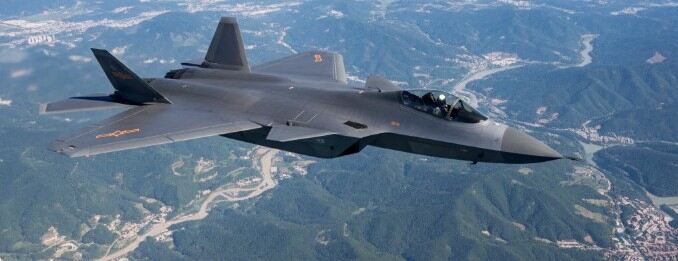
The Chengdu J-20 is the PLAAF’s first operational fifth-generation fighter and remains the largest stealth fighter in service with China. Open-source tallies indicate rapid production growth: widely cited counts and assessments put the J-20 fleet well into the hundreds as of 2024–2025, marking a major industrial shift in China’s ability to field large stealth aircraft China at scale. These numbers underscore the J-20’s role as the immediate, fielded component of China’s broader low-observable fleet.
The J-20’s mission set — long-range interception, air superiority and standoff engagement with internal weapon bays — makes it the primary operational manifestation of China’s push for larger stealth platforms and increased aerial reach. The presence of more than one stealth fighter type in Chinese service (J-20 plus evolving J-35/J-35A family) further highlights a multi-track strategy toward large stealth aircraft China modernization.
Key Features of the J-20 Chinese Stealth Aircraft
1. Stealth-Optimized Design
- The J-20’s airframe features smooth surfaces, blended fuselage edges, and canted tail fins to minimize radar reflection.
- Its canard-delta wing configuration enhances maneuverability while maintaining a low radar cross-section (RCS).
- The intakes are designed to reduce radar visibility from the front, hiding the engine’s compressor blades — a major radar-reflective component.
2. Radar-Absorbent Materials (RAM)
- The J-20 is coated with radar-absorbent materials that help absorb and scatter radar waves, reducing its signature even when flying at higher altitudes.
- China’s research into metamaterials and composite skin coatings has likely improved its stealth performance against advanced radar systems.
3. Internal Weapons Bays
- Unlike older fighters that carry weapons externally, the J-20 hides missiles and bombs inside internal bays to preserve stealth.
- It can carry long-range air-to-air missiles (like the PL-15) and potentially air-to-surface weapons for strike missions.
- The aircraft uses side weapon bays for quick-launch short-range missiles, giving it both stealth and speed in combat response.
4. Advanced Avionics and Sensor Fusion
- The J-20 features a fully digital glass cockpit and an advanced sensor fusion system, combining data from multiple sources (radar, infrared, electronic signals) into one unified tactical picture.
- It reportedly uses Active Electronically Scanned Array (AESA) radar, comparable to those found in U.S. fifth-generation fighters like the F-35.
- The aircraft’s Electro-Optical Targeting System (EOTS) and Distributed Aperture System (DAS) improve situational awareness and threat detection.
5. Supercruise Capability (Emerging Feature)
- Early J-20 models used Russian AL-31F engines, but China is now integrating its indigenous WS-15 engines.
- The WS-15 aims to deliver supercruise (sustained supersonic flight without afterburner), improving range and reducing infrared emissions — both critical for stealth.
6. Long Range and Large Airframe
- As a large stealth aircraft, the J-20 has a longer range and more internal fuel capacity than typical fighters.
- This makes it ideal for long-distance interception and patrol missions over the South China Sea or East Asia.
- Its design suggests both air-superiority and limited strike roles, blurring the line between a fighter and a light bomber.
7. Networked Warfare Integration
- The J-20 is believed to operate as part of a networked combat system, communicating securely with AWACS, drones, and ground stations.
- It may serve as a “sensor node”, sharing target data with other aircraft — similar to the U.S. F-35’s concept of “information dominance.”
8. Low Infrared and Electronic Signature
- The WS-15 engine’s exhaust design and internal cooling systems reduce infrared visibility, making the J-20 harder to lock onto with heat-seeking missiles.
- The aircraft also uses low-probability-of-intercept (LPI) radar modes to avoid detection by enemy electronic intelligence systems.
9. High Maneuverability
- Despite its stealth design, the J-20 retains strong agility through thrust-vectoring controls and its canard-delta wing setup.
- This combination allows dogfight-level agility while still maintaining low observability.
10. Strategic Role and Global Impact
- The J-20 represents China’s first operational fifth-generation stealth fighter, giving it a credible rival to U.S. F-22 and F-35 aircraft.
- Its range, payload, and stealth make it suitable for defending long borders and projecting power over disputed regions.
- Experts believe it is evolving into a multirole platform capable of air superiority, ground attack, and electronic warfare missions.
Quick Technical Summary of j-20
| Feature | Specification (Approx.) |
|---|---|
| Manufacturer | Chengdu Aerospace Corporation |
| Role | Stealth Air Superiority Fighter |
| First Flight | 2011 |
| Entered Service | 2017 |
| Length | ~20.4 m (66.9 ft) |
| Wingspan | ~13.5 m (44.3 ft) |
| Max Speed | Mach 2.0+ |
| Combat Range | ~1,200–2,000 km (depending on mission) |
| Engines | WS-15 (latest variant) |
| Armament | PL-10, PL-15, PL-21 missiles (internal) |
| Stealth Level | Comparable to 5th-generation fighters |
The projected strategic leap: Xi’an H-20 and the promise of a Chinese stealth bomber
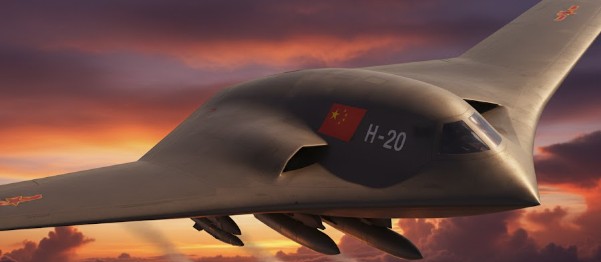
The Xi’an H-20 has been discussed in defense circles since its announcement as a strategic program in 2016. If realized, the H-20 would represent China’s first purpose-built, long-range stealth bomber — a true “large stealth aircraft China” in the bomber category capable of extended standoff and possibly intercontinental missions. Public, unclassified information about the H-20 remains limited; analysts treat it as a strategic priority but still a program with significant unknowns around prototypes, engines and timelines.
U.S. and allied intelligence reporting suggests the H-20 — intended as a flying-wing or blended flying-wing design in many speculative briefs — would substantially expand PLA strike options if it reaches maturity, especially when combined with aerial refueling and modern precision weapons. That potential makes the H-20 one of the most consequential entries under the umbrella term large stealth aircraft China even before it enters service.
Key Features of the Xi’an H-20 Chinese Stealth Aircraft
1. Flying-wing / tailless design for reduced radar cross-section
The H-20 is reported to adopt a flying-wing layout (or at least a blended planform without conventional tail surfaces) to minimise its radar signature — a key stealth attribute.
- The “cranked-kite” wing shape (similar in concept to the B‑2 Spirit) is cited in modelling and concept art.
- Serrated air-intakes and flush surfaces help obscure the engine compressors from radar.
2. Very long range / intercontinental reach
One of the standout attributes of the H-20 is its intended long-range capability, allowing it to strike targets at extended distances — a major leap compared to China’s earlier bombers.
- Estimates suggest a range of at least ~8,500 km (and some sources even list “more than 10,000 km”).
- This range would enable China to project power beyond the “Second Island Chain”, reaching U.S. territories and other strategic locations.
3. Dual nuclear and conventional capability
The H-20 is intended to serve both nuclear-and-conventional strike roles — enhancing strategic flexibility.
- Reports state it will integrate into China’s airborne leg of its nuclear deterrence, while also being usable for precision conventional missions.
- The internal weapons bays and large payload capacity further support this dual role.
4. Large payload capacity and internal weapons carriage
To maintain stealth, weapons must be carried internally rather than slung externally. The H-20 appears designed with this in mind.
- Payload estimates: carrying ~10 + tonnes (or more) internally. Some sources mention up to 45 tonnes in total for take-off weight or munitions capacity.
- Internal weapons bays (reducing external radar reflectors) contribute to its low observability.
5. Optimized stealth features and signatures
Beyond shape and internal carriage, the H-20 is reported to incorporate advanced stealth features:
- Use of radar-absorbent materials (RAM) and composites on outer skin.
- Serrated trailing-edges, low-profile inlets, and flush panel lines to reduce radar reflections.
- Dark grey coatings and surfaces designed to reduce IR and visual detection, according to modelling.
6. High survivability in contested airspace
Because it is intended for deep-penetration missions into high-threat zones (with advanced air-defences), the H-20’s design emphasizes survivability:
- Flying-wing/low-observable architecture helps in avoiding detection and engagement.
- The range and payload give it flexibility to launch from safe stand-off distances or via aerial refuelling—reducing exposure.
7. Strategic shift for China’s air power
The H-20, if operational, would represent a qualitative jump in China’s aerospace capability:
- It marks China’s attempt to field a dedicated strategic stealth bomber rather than just fighters or adapted designs.
- It signals China’s intent to move from regional strike (e.g., over East Asia) to global strike-capable platforms.
Important caveats: what we don’t yet know
- The H-20 remains a projected/under-development aircraft — no confirmed operational status or full technical specification has been publicly verified.
- Some details (range, payload, engines) are based on analyst estimates, modelling and leaked concept art rather than official data.
- The real stealth performance (radar cross-section, sensor suites, EW capabilities) remains unproven in open sources.
Quick summary of Xi’an H-20 key features
| Feature | Description |
|---|---|
| Planform | Flying-wing / blended wing design for reduced RCS |
| Range | Estimated 8,500 km or more — intercontinental strike reach |
| Payload | Internal weapons bays, large munitions capacity |
| Dual-role | Nuclear and conventional missions |
| Stealth enhancements | RAM coatings, serrated edges, flush inlets, internal bays |
| Strategic impact | Enables China to project air power far beyond regional sphere |
In summary, the H-20 represents China’s ambition to field a large stealth aircraft capable of deep penetration into contested airspace, combining stealth, range, large payload and strategic flexibility. If realized as reported, it would markedly expand the capabilities of the People’s Liberation Army Air Force (PLAAF) — and add a new dimension to global air-power dynamics.
New prototypes and demonstrators: what imagery reveals about large stealth aircraft China programs
In late 2024 and 2025, a series of blurry photos and satellite images surfaced showing tailless and diamond-shaped designs at multiple Chinese test sites. Defense analysts and Reuters reporting concluded these images likely represent novel experimental designs — some larger than the J-20 — that indicate China is experimenting with different low-observable planforms, including tailless and flying-wing layouts that fit the description “large stealth aircraft China.” Such demonstrators are important because they show a diversification of design approaches rather than a single-platform bet.
These prototype sightings carry caveats — many images are ambiguous (demonstrator vs. production prototype; crewed vs. unmanned) — but repeated sightings across different facilities point to sustained development activity for larger stealth airframes beyond the J-20.
Parallel development: J-35/J-35A and naval variants as part of the “large stealth aircraft China” picture
China is not limiting itself to a single stealth fighter lineage. The Shenyang J-35 family (evolving from the FC-31) has surfaced as a carrier-capable and land-based stealth fighter option that complements the J-20. State media and open reporting through 2024–2025 document prototype flights, mock-ups and early production imagery — evidence that the J-35 joins the J-20 in expanding the inventory of large stealth aircraft China across both PLAAF and PLAN use cases.
Additionally, the operational testing of electromagnetic catapults aboard the new carrier Fujian, including footage of stealth fighters launching and recovering, indicates China’s intent to integrate stealth jets into carrier aviation — a force multiplier for China’s large stealth aircraft ambitions.
Industrial, technical and doctrinal hurdles for large stealth aircraft China
Despite fast progress, scaling up large stealth aircraft China programs faces concrete challenges:
- Engines: High-performance, reliable turbofans remain an area where Chinese aircraft programs must close the gap. Large stealth platforms demand engines with specific thrust, thermal and maintenance characteristics.
- RAM and manufacturing at scale: Producing radar-absorbent materials and maintaining precision tolerances across dozens or hundreds of large stealth airframes is technically and logistically demanding.
- Systems integration and sensors: Performance depends on matured avionics, sensor fusion and datalinks — not only stealth shaping. The operational effectiveness of any large stealth aircraft China program will hinge on integration, pilot training and supporting ISR and refueling networks.
Strategic implications: how large stealth aircraft China changes regional calculations
The emergence of multiple large stealth aircraft China types — operational fighters like the J-20 and J-35, and potential bombers such as the H-20 — alters regional deterrence dynamics. Larger stealth platforms complicate air-defense planning, increase the need for counter-stealth sensors, and shift procurement priorities for nearby states and U.S. forces operating in the Indo-Pacific. Satellite deployments of advanced bombers or even H-6 variants to contested islands have already been used as signaling tactics, showing how new and legacy bomber assets factor into Beijing’s regional posture.
What to watch next (practical signals)
To track progress on large stealth aircraft China, watch for:
- Confirmed test flights and official flight imagery released by Chinese state media.
- Repeated satellite sightings of prototype airframes and production line photographs that show serial numbers and assembly activity.
- Official induction announcements, airshow debuts with service markings, and carrier-based integration footage.
Conclusion
The phrase large stealth aircraft China now describes a multi-dimensional program: fielded heavy stealth fighters (Chengdu J-20), a second stealth family (J-35/J-35A), and a possible strategic stealth bomber (Xi’an H-20), plus several experimental flying-wing prototypes. While fielded fighters already alter regional airpower balance, the H-20 and larger demonstrators remain the critical unknowns. Their maturation — or lack of it — will determine whether China truly fields a family of large stealth aircraft that reshapes long-range strike and deterrence in the decades ahead.